Auburn, Washington · Heating and cooling referrals
White River Heating and Air is a specialist research and referral service for HVAC repair and replacement in Auburn. One call connects you with an independent local pro. No charge to call, and no obligation until you approve a written estimate.
White River Heating and Air is a free referral service. We connect you with an independent local pro; we do not perform the work ourselves.
This line is operated from the United States. You reach a US based operator, not a call center overseas.
Serving Auburn ZIP codes 98001, 98002, 98071, 98092, across the White River service area and the neighborhoods named below.
The latest published national guides put common HVAC repairs between about $150 and $650, furnace replacement between about $3,000 and $7,000 installed, and full matched system replacement commonly between about $5,000 and $12,000 for a typical home. Auburn reads those bands through valley weather. Long rainy winters and valley fog keep heat pumps working in damp air for months, while mild dry summers mean cooling failures here are rarer and often simpler than the heating side. Postwar neighborhoods on the valley floor, hillside subdivisions above it, and newer subdivisions at the county edge, many with heat pumps, split the housing stock into damp floor homes and exposed hillside homes, and the same repair can be sound money in one and poor money in the other. Ask for the repair versus replacement arithmetic in writing, with system age and condition doing the arguing. This 2027 guide localizes the latest published national figures for ZIP codes 98001, 98002, 98071, and 98092.
Nothing. The call and the referral are free, and there is no obligation to hire anyone.
Only after the pro has seen the job and you have approved a written estimate. Approving the price is always your decision.
An independent local contractor who takes this kind of work in Auburn. You deal with them directly, and you can verify licensing and insurance before hiring.
No. This service is run by a US based routing team. Real people here route your call to a local pro.
Emergency HVAC in Auburn, shaped by valley and hillside homes with heat pumps where wet winters and year-round heat pump runs wear systems at both ends.
Call PLACEHOLDER
Furnace diagnosis and repair in Auburn, shaped by valley and hillside homes with heat pumps where wet winters and year-round heat pump runs wear systems at both ends.
Call PLACEHOLDER
Matched furnace and cooling replacement in Auburn, shaped by valley and hillside homes with heat pumps where wet winters and year-round heat pump runs wear systems at both ends.
Call PLACEHOLDER
Diagnosis and repair of air conditioning that blows warm, runs without cooling, freezes up, or has stopped altogether in Auburn, shaped by valley and hillside homes with heat pumps where wet winters and year-round heat pump runs wear systems at both ends.
Call PLACEHOLDER
Service and installation for heat pumps: systems icing up, blowing cool air in heat mode, leaning on auxiliary heat, or due for replacement in Auburn, shaped by valley and hillside homes with heat pumps where wet winters and year-round heat pump runs wear systems at both ends.
Call PLACEHOLDER
Finding and fixing the duct failures behind hot and cold rooms: collapsed, disconnected, leaking, and undersized runs that waste the system you already own in Auburn, shaped by valley and hillside homes with heat pumps where wet winters and year-round heat pump runs wear systems at both ends.
Call PLACEHOLDER
Seasonal maintenance visits that clean, test, and measure the system before the season that will punish it: coils, drains, electrical, and safety checks in Auburn, shaped by valley and hillside homes with heat pumps where wet winters and year-round heat pump runs wear systems at both ends.
Call PLACEHOLDER
Design and installation of ductless mini-split systems for additions, garages, converted spaces, and homes where ducts do not reach or do not exist in Auburn, shaped by valley and hillside homes with heat pumps where wet winters and year-round heat pump runs wear systems at both ends.
Call PLACEHOLDER
Assessment and improvement of indoor air: filtration upgrades, humidity control, and ventilation fixes for dust, odor, and allergy complaints that track with the HVAC system in Auburn, shaped by valley and hillside homes with heat pumps where wet winters and year-round heat pump runs wear systems at both ends.
Call PLACEHOLDERDescribe what you are seeing. One free call connects you with an independent local pro who can assess it in person.
PLACEHOLDERAuburn HVAC work in 2027 is priced from a written scope naming the failed part or the sizing basis, the system condition behind it, and the valley conditions it must serve, checked against the latest published national figures.
See cost ranges and how insurance paysIn order of how often they are found: a clogged filter or blocked airflow, a failed capacitor or fan component, low refrigerant from a leak (refrigerant is not consumed; low means leaking), a frozen coil from any of the above, and duct failures dumping cooled air into the attic. Runtimes of many hours without reaching the set point are the classic forum complaint and they sort into the same list. Turn a frozen system off and run the fan to thaw it, and never approve a refrigerant recharge without a leak search; topping off a leaking system is a subscription, not a repair.
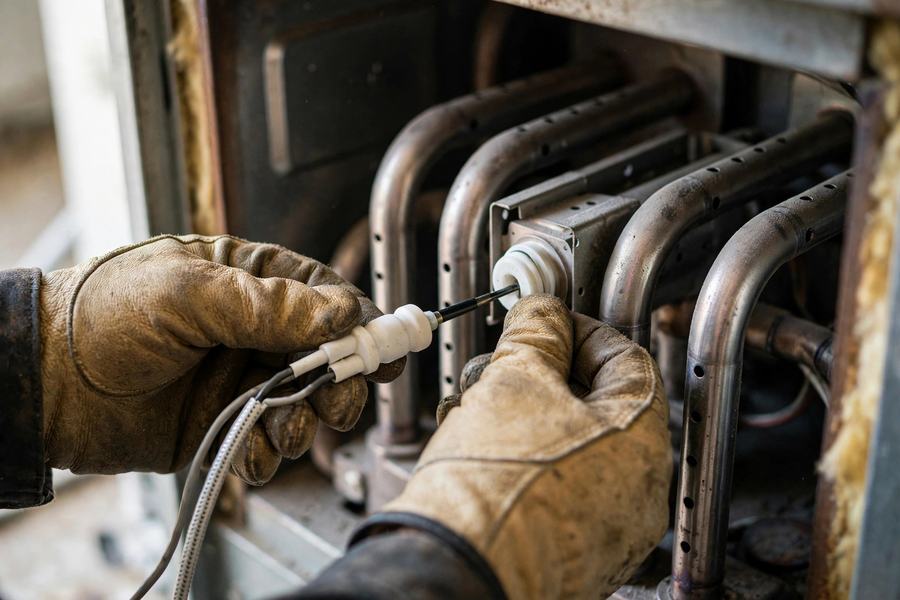
The furnace starts in a sequence, and clicking without heat means one step failed: the inducer proves the vent, the igniter glows or sparks, the gas valve opens, and the flame sensor proves flame. A sensor filmed with oxide, a cracked igniter, and a failing inducer motor are the common findings, roughly in that order, and each is a part level repair. What it is not, usually, is the thermostat. If you smell gas at any point, stop: leave, and call the gas utility or emergency services before any repair call.
Use the arithmetic the trade uses: multiply the repair quote by the system's age in years. Past roughly 5,000, replacement usually wins; well under, repair usually wins. A $400 repair on a 15 year old system (6,000) sits on the line; a $1,800 compressor on the same system (27,000) is well past it. Add the condition evidence: refrigerant type on older cooling systems, duct condition, and whether this is the first major repair or the third. Any company should show you both prices in writing; a replacement pitch without a repair price is a sales call, not a diagnosis.
Published national guides put full system replacement commonly between $5,000 and $12,500 or more installed, with size, efficiency tier, fuel type, and duct work deciding where a house lands. Single component repairs run $150 to $650 for most findings, and a diagnosis visit runs $75 to $200. The honest quote separates equipment, duct corrections, and electrical or venting changes into lines, because the duct line is where replacement quotes quietly differ by thousands between companies measuring the same house.
Turn the cooling off and run the indoor fan. A frozen coil is a symptom, usually of low airflow (filter, blower, closed or blocked vents) or low refrigerant from a leak, and running the system frozen risks the compressor, the most expensive part in the system. Let it thaw fully (hours, not minutes) before a technician tests it, because readings on a frozen coil lie. Do not chip the ice. If it freezes again after a filter change, the cause is refrigerant side or blower side, and that is a diagnosis visit, not another thaw.
Once a year per function: cooling before the heat season, heating before the cold season, which for most homes means one or two visits a year. The work that matters is unglamorous: coils cleaned, the condensate drain flushed (its failure is the one that floods ceilings), electrical components tested against readings, and safety controls proven on heating equipment. Shoulder season scheduling is the practical advice: the same visit in the first heat wave joins a queue of people whose systems already failed.
Only when a covered event causes it. Wear, age, and mechanical failure are maintenance and are not covered anywhere. Lightning strikes and power surge damage from a storm event, and fire or storm damage to equipment, are the covered kind, subject to your deductible, and they need documentation: the storm date, the surge evidence, and a technician's finding that ties the failure to the event. A compressor that dies of age in the same week as a storm is still age unless the electrical evidence says otherwise, which is why the diagnosis report matters.
Probably not on that evidence alone. Heat pumps deliver air at roughly 90 to 100 degrees, below skin temperature, so it feels cool on your hand while still heating the house; a furnace delivers noticeably hotter air in shorter bursts. The real tests are whether the house holds its set point, whether ice on the outdoor unit clears in defrost, and whether auxiliary heat is running constantly (the electric bill notices that one). If the house drifts colder while the unit runs, or the unit stays iced, that is a service call with a real fault behind it.
The AC Runs All Day and Loses: A Auburn Diagnosis Order: If the system runs for hours and the house never reaches the set temperature during a...
What HVAC Repair and Replacement Cost in Auburn: The 2027 Guide: If ice shows on the refrigerant line or the indoor coil, shut the system down and...
This service runs with US based staff. We connect you with independent local contractors and we stay accountable for that connection.
Prefer to talk later? Leave your details and an independent local pro will call you back. No charge to you, no obligation.
White River Heating and Air is a free referral service. Submitting this form connects you with independent local contractors who provide the work.
Calls are answered 24/7. One call connects you with an independent local pro.
PLACEHOLDER